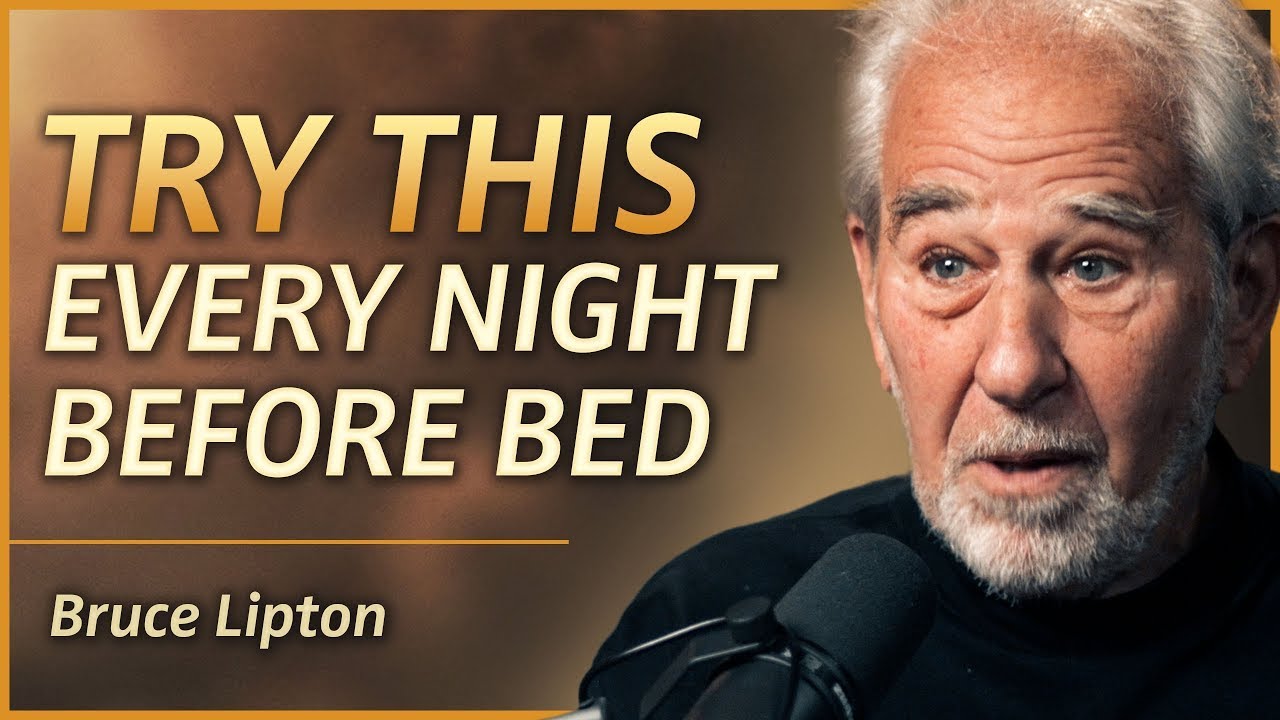
You were told your genes are your destiny. A cell biologist looked closer and found the opposite. You're not stuck with what you were handed.
Maybe it's true. Maybe it's not. See what resonates for you.
For years Bruce Lipton taught the central dogma of biology: genes control life. Then, studying cloned cells, he noticed something that didn’t fit. Identical cells placed in different environments became different cells. The genes hadn’t changed — the environment had. The control wasn’t coming from inside the DNA. It was coming from outside the cell. That single observation undid decades of what he’d been teaching.
Conventional biology says the nucleus — where the DNA lives — is the brain of the cell. Lipton argues it’s actually the membrane, the outer skin of the cell that reads the environment and decides how the cell responds. Remove the nucleus and a cell keeps functioning for weeks. Remove the membrane and it dies instantly. The cell’s intelligence, he says, lives at the boundary where it meets the world.
The field that grew from this insight is real and mainstream. Epigenetics studies how gene expression is switched on and off by signals from the environment — diet, stress, toxins, emotional state. You are not running a fixed genetic program. You are constantly responding. This is the confirmed, foundational science underneath everything else Lipton says.
Here’s where Lipton extends into bigger territory. He argues that roughly 95% of your daily life runs on subconscious programming installed mostly before age seven — and that “thinking positive” with the conscious 5% can’t override it. The fix, he says, is reprogramming the subconscious directly. The psychology partly supports this; the specific 95% figure is more of a useful frame than a measured fact.
This is the heart of it, and it’s why Lipton resonates with so many people. If your genes don’t control you — if environment and perception shape your biology — then you are not stuck. The diagnosis isn’t destiny. The family history isn’t a sentence. You have more influence over your own biology than you were ever taught. That’s the freeing idea. Whether you take it as far as Lipton does is, as always, yours to decide.
This is one of the more grounded entries in the Maybe library, so it's worth being precise about where the science is solid and where Lipton reaches.
The confirmed part: epigenetics is real, mainstream, and foundational to modern biology. Genes can be switched on and off by environmental signals — including stress, nutrition, and emotional state. Lipton was genuinely early to this, and the field has validated that core insight. That's not fringe. That's textbook now.
The reaching part: Lipton extends this into broader claims about belief reprogramming, the subconscious running 95% of your life, and "designing your destiny." Some of this is supported by psychology, some of it stretches further than the hard data goes. The 95% figure, for instance, is widely repeated in this space but isn't a settled scientific measurement.
Maybe's read: the foundation is solid science, the application is hopeful interpretation. Both can be useful — just know which is which. Use your discernment.
These claims are tracked over time on the Claims board. Statuses reflect only this episode — not the source's full body of work.
Said in this episode but not promoted to a tracked claim with its own deadline — noted here so nothing gets lost, in case it matters later.
Lipton sits at the heart of one of Maybe's strongest convergences: Lipton + Joe Dispenza + Gregg Braden all arrive at the same conclusion — consciousness and environment shape biology — from three different angles. Lipton through cell membranes and epigenetics, Dispenza through meditation brain scans, Braden through emotion and DNA studies. Three methodologies, one conclusion: you are not a victim of your biology.