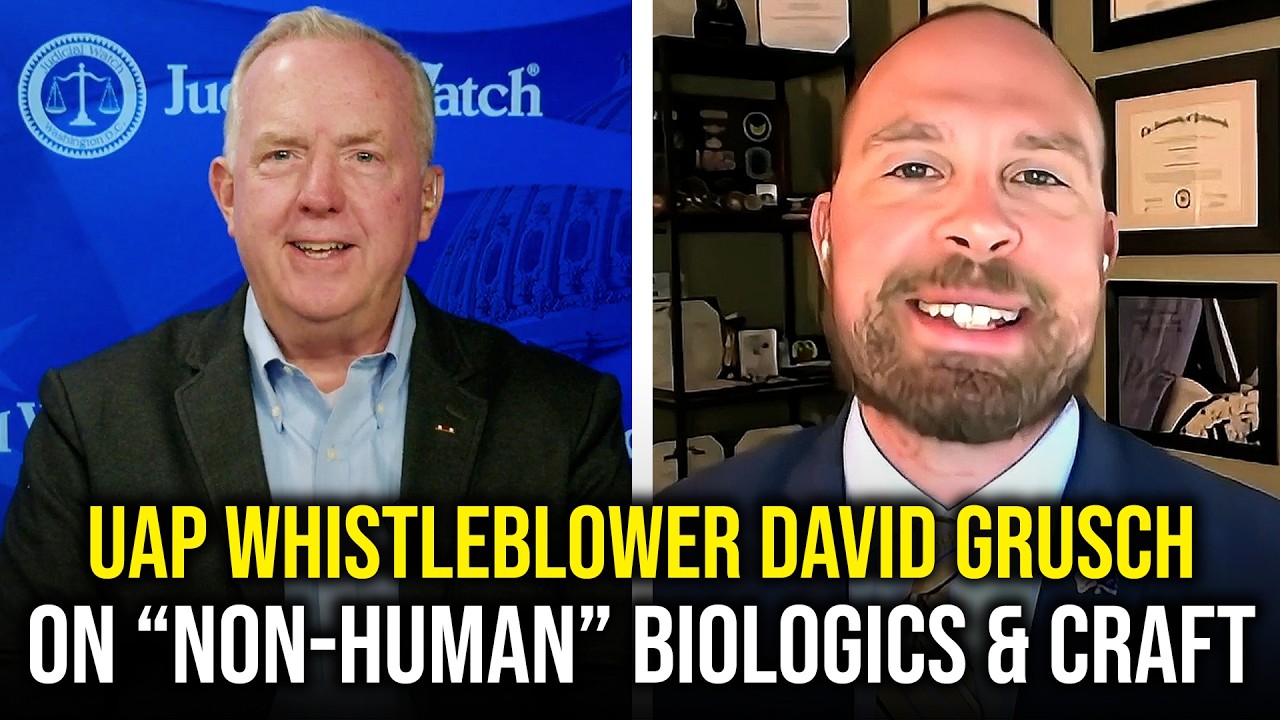
What does a man with the deepest security clearances refuse to say, even when he could? That refusal might be the most credible thing about him.
Maybe it's true. Maybe it's not. See what resonates for you.
Most of this story gets told as “what’s in the hangar.” Grusch is more interested in something quieter: how you’d hide a hangar in the first place. He spent his career inside the machinery of secrecy — watching how funding gets quietly shuffled, how programs get renamed to throw people off the scent, how even senior officials get the maddening “I can tell you it exists, but not what it is.” That’s the real source of his credibility. He’s not the guy claiming to have seen everything. He’s the guy who can explain how something this big could stay hidden in plain sight — which is a lot harder to wave away.
Here’s the core claim, stated as plainly as he states it: the government holds recovered craft of non-human origin. More than one. Fewer than a hundred. Tucked away in secure facilities, custody quietly passed between agencies and contractors over the decades. He says he checked it “all the way up the flagpole” with senior sources. Everything else in the story leans on this one load-bearing claim — and it’s also the one official reviews flatly deny. Hold both of those facts at once. That’s kind of the whole job here.
This is the moment that tells you the most about him. Asked point-blank if it’s aliens, Grusch doesn’t grab the headline. He says “non-human intelligence” and stops. He’s a physics guy, he never had full access to the technical findings, so he won’t pretend to know what he doesn’t. Sit with how unusual that is. He’s got every incentive to say the big thing — and he chooses the smaller, more careful word instead. In a space where certainty is the main product, restraint like that stands out.
Grusch is candid about what going public did to his life. An Espionage Act complaint from the Air Force in 2023 (later denied). A press story dragging his PTSD history into public view. And what he calls the whispering campaign — “Dave’s radioactive” — aimed at the messenger rather than the message. He says friends who helped him got hit too, some out of work for years. You don’t have to buy his biggest claims to find this part sobering. It’s a clear look at what happens to someone who steps outside the lines and won’t step back.
Asked to look ahead, Grusch won’t name a date — “there’s a lot of causal factors,” he says, which is a very intelligence-officer way to dodge — but he’ll go this far: he expects things to escalate in the next 60 to 90 days. He points to Congress fighting to declassify dozens of videos, to subpoena power, to lawsuits stacking up. And then, almost refreshingly, he undercuts his own hype: the videos don’t prove the case, and the legal road is a multi-year slog probably ending at the Supreme Court. Hopeful about the momentum, honest about how slowly the machine turns. The best part for you as a reader? We’re inside that 60-to-90-day window right now. So this isn’t a prediction you have to take on faith. It’s one you get to watch.
This is the most credentialed voice in the Maybe library, so it's worth being careful about what's established and what isn't.
What's solid: Grusch's background is real and on the record. Fourteen-plus years in intelligence, a clearance held for 21 years, senior roles at two intelligence agencies, sworn testimony to Congress in 2023, and a current job as special adviser to a sitting Congressman. He also has a real FOIA lawsuit on the federal docket. These are facts, not claims.
What's contested: his central allegation — that the government holds recovered non-human craft — is firmly denied by serious people. A 2024 Pentagon review (AARO) found no verifiable evidence the U.S. possesses extraterrestrial technology or runs hidden reverse-engineering programs. Former AARO director Sean Kirkpatrick, Representative Mike Turner, and Pentagon spokespeople have all pushed back. General Mark Milley said he never saw evidence supporting the claims. Grusch addresses these denials in the interview — but addressing a denial isn't the same as disproving it. No physical proof has been shown to the public.
A note on framing: this interview aired on Judicial Watch, a politically conservative organization. That doesn't make the content true or false — Maybe summarizes across the spectrum — but you should know the room a conversation happens in.
Here's Maybe's actual read. The most credible thing about Grusch is what he won't say. He won't confirm extraterrestrial origin. He admits the videos don't prove his case. That's not weakness in his account — it's the tell of someone trying to stay honest. Credible and proven are two different words, and the whole library lives in the gap between them. Grusch sits right on that line. Use your discernment.
These claims are tracked over time on the Claims board. Statuses reflect only this episode — not the source's full body of work.
Said in this episode but not promoted to a tracked claim with its own deadline — noted here so nothing gets lost, in case it matters later.
This is the most interesting cross-reference in the entire Maybe library. Grusch lands on roughly the same conclusion as Ismael Perez, Elizabeth April, and Bashar — disclosure is close, something is here — but he gets there through security clearances and sworn testimony instead of channeling, remote viewing, or contact. When voices from completely different methods point the same direction, that convergence is worth noticing. It's also worth noticing the difference in tone: the esoteric voices tend toward certainty, while the man with the clearances keeps hedging. Alongside Matias De Stefano, Grusch is one of the only voices in the library making claims you could one day actually check.