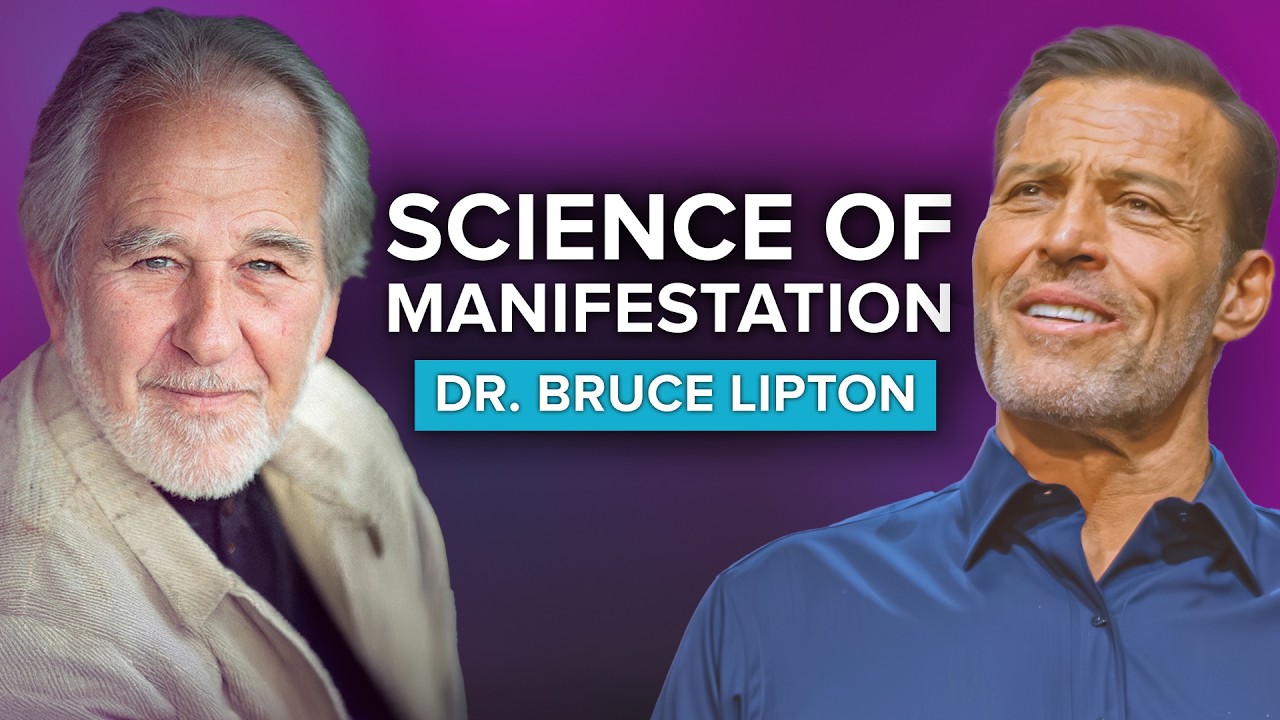
He says the story of DNA left out a woman — and left out you. Genes, he says, were never in charge to begin with.
Maybe it's true. Maybe it's not. See what resonates for you.
The 1953 DNA breakthrough is credited to Watson and Crick — but the X-ray data that revealed the structure came from Rosalind Franklin, whose research was passed to them without her knowledge and whose name never appeared in their published paper. Real history, not a Lipton theory.
Lipton’s central claim: less than 1% of disease is directly caused by a single gene. The rest, he argues, comes down to lifestyle and environment acting on genes that are otherwise just blueprints, switched on and off from outside.
His evidence: identical twins who diverge sharply in health over decades despite starting with the same DNA, and a real study by physician Dean Ornish where prostate cancer patients changed hundreds of genes’ activity through diet, stress reduction, and lifestyle alone.
Leaning on early 20th-century quantum physics, Lipton argues atoms are mostly energy, not solid particles — and that consciousness itself is a documented, measurable force shaping the physical world, not a side effect of it.
Before age seven, he says, children absorb their family and culture’s beliefs through observation, not conscious choice — installing a subconscious “operating system” that he claims runs about 95% of adult behavior on autopilot.
In the closing stretch, Lipton compares COVID-19’s severity to seasonal flu and argues against statins and injectable vaccines generally. These claims sit outside his own specific field of cell biology and epigenetics — worth weighing with that in mind, and worth a real doctor’s input over a podcast’s.
Lipton has a real and legitimate scientific background — a PhD, a run at Stanford, decades of actual published research on epigenetics, which today is a mainstream, peer-reviewed field. The "genes don't act alone" thesis isn't fringe. The Rosalind Franklin history and the Dean Ornish study are both real and checkable.
Two things worth flagging clearly. First: this talk was recorded in 2020, right near the start of the pandemic — his COVID comments reflect that early moment, not a fresh 2026 read of years of data we now have. Second: the COVID-severity, statin, and vaccine claims move outside his specific field of training (cell biology and epigenetics, not virology, epidemiology, or pharmacology) and go against current mainstream medical consensus. That doesn't automatically make them wrong, but it's exactly the kind of claim where "who is speaking" and "what field they're speaking in" matter — and it's the kind of claim we'd point you toward a doctor for, not a podcast. We're tracking the two sharpest, most specific numbers he gives so they can actually be checked against the published data, rather than just repeated.
These claims are tracked over time on the Claims board. Statuses reflect only this episode — not the source's full body of work.
Said in this episode but not promoted to a tracked claim with its own deadline — noted here so nothing gets lost, in case it matters later.
Sits in the same Consciousness Shapes Biology cluster as Gregg Braden and Joe Dispenza. Worth noting for the discernment record: Lipton's academic credentials (PhD cell biologist, Stanford research history) are more directly verifiable than some other voices sharing this lens — a useful data point when weighing "who's speaking," separate from whether any individual claim holds up.
For one week, notice the moments you're running on autopilot versus actually choosing. Lipton's claim is that 95% of your day runs on programs installed before you turned seven. You don't have to fix anything today — just catch yourself mid-program once or twice and notice what it feels like.