What if the things you criticize yourself for the most were never flaws at all — but clever ways a younger you found to stay safe?
Maybe it's true. Maybe it's not. See what resonates for you.
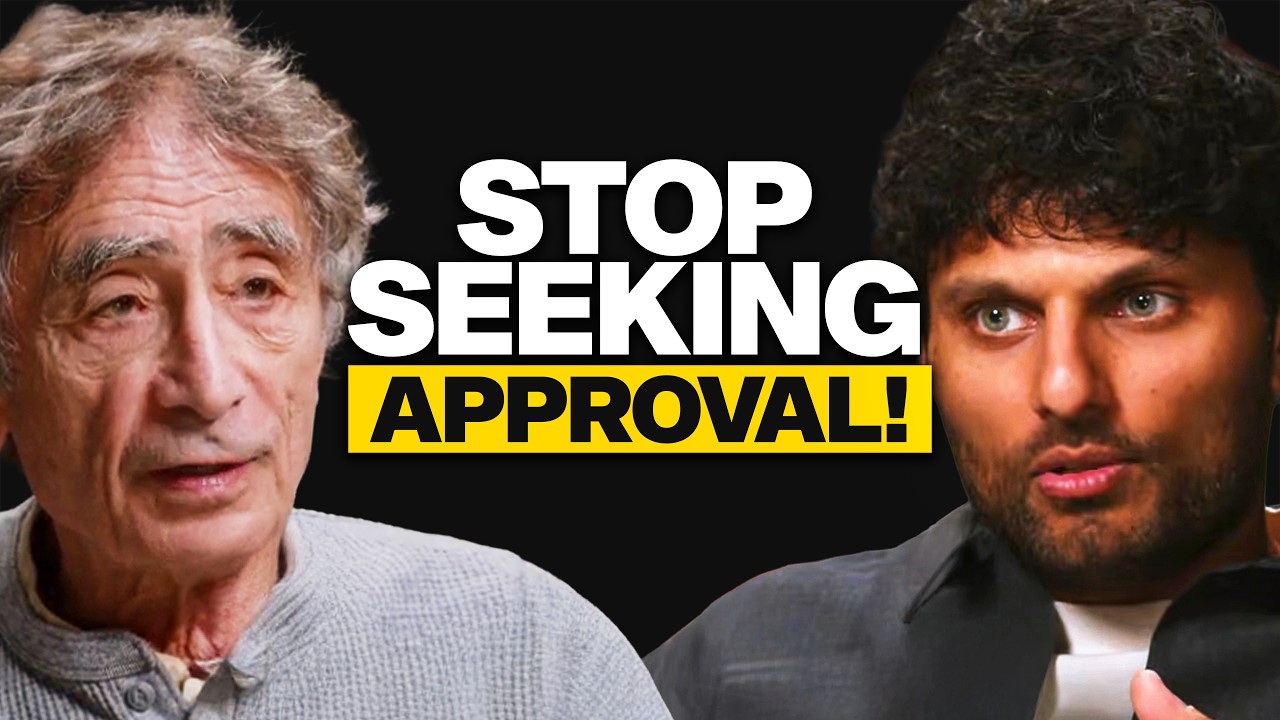
Maté opens with a line from the monk Thomas Merton: we live in other people’s minds. When we’re constantly tracking how we’re perceived — how others see us, judge us, approve of us — we’re not actually living in ourselves at all. He traces it back to a real developmental need. A child doesn’t just need food and shelter; they need to be seen for who they truly are. When a parent can’t quite do that, often through no fault of their own, the child quietly adjusts: hiding some parts, exaggerating others, building an image worth loving. The performance starts early, and most of us never notice we’re still running it.
Here’s the distinction that does the most quiet damage. Maté shares it from his mentor, the trauma pioneer Peter Levine, who told him: “If I ask, have I done enough? — the answer is yes. But if I ask, am I enough? — I still don’t know.” That gap is where so much suffering lives. We’ve been trained to measure our worth by what we produce, so we tie our value to output, busyness, titles, followers. Maté’s gentle counter: would you ever tell a one-day-old baby, who can do nothing at all, that they’re not enough? Of course not. So why say it to yourself?
If our worth is what we do, then doing nothing feels like failing. Maté admits he lived this for years as a workaholic family doctor, feeling guilty taking a holiday because a patient might give birth without him. “Imagine somebody in the world is born without me,” he laughs. “How did humanity survive all those millions of years?” The guilt around rest, he says, comes straight from that same buried belief: that we’re not valuable simply for existing. Naming it is the first crack in it.
This is the practical heart of the episode, and the easiest thing to take home. Maté’s first question is simple: where in your life are you not saying no? Not out of stubbornness — but where is there a no your body wants to speak that you’re swallowing because you’re afraid of how you’ll be perceived? He points out that “no” is one of the first words a toddler learns, and that we punish it out of them, then wonder at forty-five why they can’t set a boundary. The companion question is just as important: where are you not saying yes — to the creative pull, the desire, the life you actually want — because you’re too busy not saying no? He even offers a gentler version, borrowed from Eckhart Tolle: the “high quality no,” where you honor yourself without making the other person wrong.
The idea that ties it all together, and the one most likely to stay with you. Everything you criticize yourself for — disconnecting from your gut, people-pleasing, going quiet — began as an adaptation. He tells the story of an indigenous elder, ashamed she’d forgotten her native language, until he gently showed her that forgetting it as a terrified child in a residential school was her body’s wisdom keeping her alive. What looked like cowardice was survival. None of it was a moral failure. And if that’s true, then self-improvement doesn’t have to be an accusation against yourself. Reframe it, he says, as one open question instead: how can I reach my full potential? No judgment in it. Just a lifelong, kinder inquiry — and underneath it all, the only question he’d want you to carry home: what is true for me?
Quick honesty, because Maybe runs on it: I'm not a doctor. I'm a curious guy with an internet connection doing my best to make sense of this stuff alongside you. So take this as a friendly nudge, not a ruling from on high.
Here's roughly where things seem to land. The stress part feels solid — that the body's stress response helps you in a crisis but wears you down over the long haul is pretty well-accepted, and Maté explains it more beautifully than most. The part where he draws a straight line from buried emotion to specific diseases like autoimmune conditions or cancer is where I'd gently raise an eyebrow — there's real research linking stress to illness, but "the body says no through this exact disease" reaches a bit past what anyone's actually proven. Compelling lens. Not settled fact.
And honestly? Most of this episode isn't a medical claim at all. "Where am I not saying no?" "Have I done enough versus am I enough?" "What is true for me?" Those aren't science. They're just good questions. And good questions don't need a peer review to be worth sitting with on the drive home.
So that's my two cents, worth exactly what you paid for it. Take what feels true, leave the rest. Use your discernment.
These claims are tracked over time on the Claims board. Statuses reflect only this episode — not the source's full body of work.
Said in this episode but not promoted to a tracked claim with its own deadline — noted here so nothing gets lost, in case it matters later.
Maté connects to one of Maybe's strongest threads. His insight that emotional and physical health are inseparable — that the mind shapes the body measurably — lands in the same territory as Bruce Lipton, Joe Dispenza, and Gregg Braden, who each arrive there through cell biology, meditation research, and DNA studies. Maté gets there through clinical work with patients. Four different doors, one room: you are not a passive victim of your biology. His emphasis on returning to a quiet inner knowing — "what is true for me?" — also rhymes gently with Eckhart Tolle's presence and Sara Landon's idea that the answers are already inside you.