maybe.earth
← Summaries
Maybe Summary

Matias De Stefano

Heart Coherence Collaborative (YouTube)
Originally aired: Premiered July 6, 2026 — a replay of the April 26, 2026 conversation
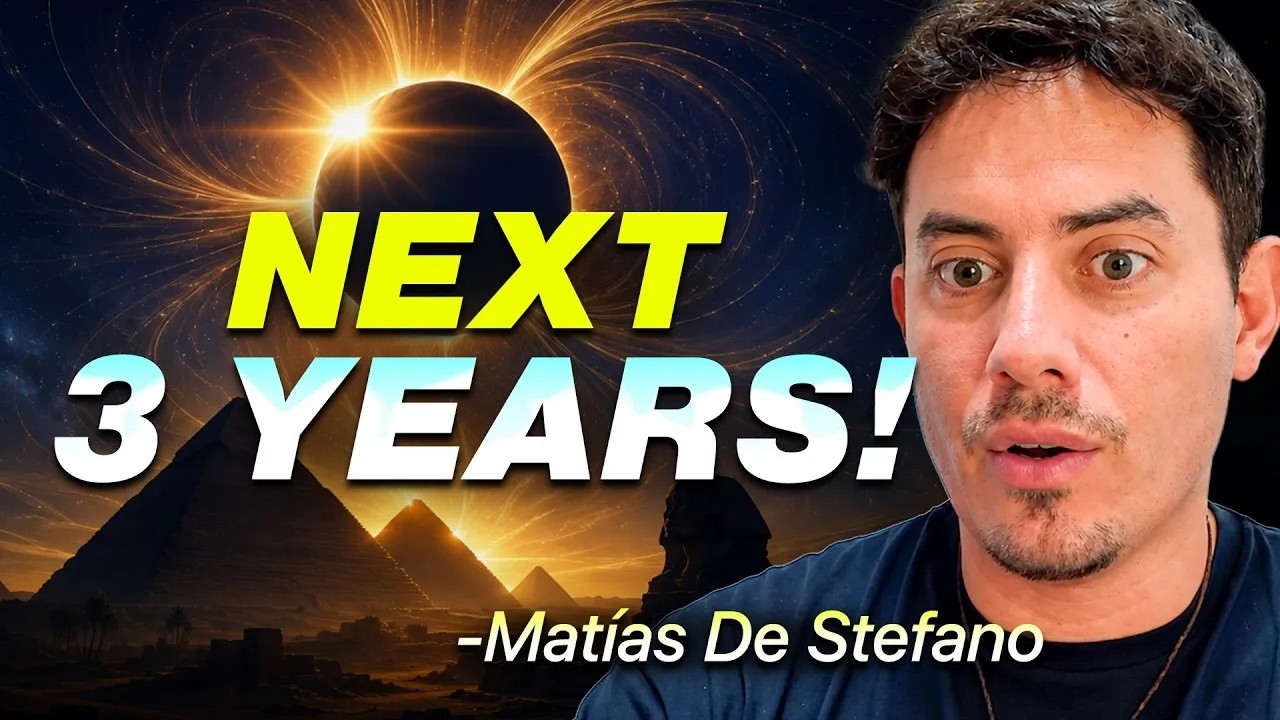
Video thumbnail: Matías de Stefano: The NEXT 3 YEARS Will CHANGE Humanity (Here's Why) REPLAY
The source · Heart Coherence Collaborative (YouTube) · Premiered July 6, 2026 — a replay of the April 26, 2026 conversation Sixty-six minutes with a man who has two dates circled on his calendar, both of them in NASA's records, and a three-year plan for what happens between them.
In plain English. Because you deserve that.

Matias De Stefano has two dates circled. Neither one is in dispute. What they mean is the entire argument.

Two things are going to happen, and nobody serious disagrees that they will.

On August 2, 2027, the longest total solar eclipse of the century passes over Egypt. Its path runs directly above Luxor. In April 2029, an asteroid called Apophis passes closer to Earth than our own communications satellites.

Both are on our claims board already. Both came back Confirmed.

De Stefano's episode is about the gap between them — the three years he calls "an amazing test of alchemy."

Start with the eclipse. He is emphatic that Luxor is not a coincidence for him personally. He says it sits at the centre of everything he has been sharing, and he's built an entire three-year project around what he calls alchemising it. His word, repeatedly. The idea is that a moment of that scale carries force, and force is either used or endured.

His image for it is a storm. "If we don't know how to sail the boat, the waves can turn us upside down." Change is coming either way; whether it reads as chaos depends on whether you learned to navigate before it arrived.

Then Apophis, and here he gets genuinely stark. The name is Greek for Apep, the Egyptian god of destruction and chaos. He does not predict catastrophe. What he says is that the same event could land two completely different ways — in his words, either "it's nice light crossing the sky" or "it's the end for our civilization" — and that what decides which one is whatever gets triggered in the three years before it.

Underneath the astronomy is the older material, and it's the part that lingers.

He mentions a remembrance series being pulled from the vaults after years. Asked why now, he answers with something from 12,000 years ago: when children were born, he says, they were told "welcome to life, the path to death. You will be alone in the vast ocean of the universe. So you need to learn that."

Then the line he calls the most important thing he took from all his memories. Not a cosmology, not a prophecy. Just: you're going to die.

The three-year preparation, in his framing, is preparation for that — the eclipse and the asteroid are the calendar, not the point.

One last thing, and it's the most testable idea in the episode. He argues "follow your heart" isn't a spiritual platitude at all. He describes it as a calibration system — your inner rhythm tuned to the planet's magnetic field. Practically, it means respecting your own pace at accepting new information. Some people move fast, some slow, and forcing it creates stress. If something doesn't resonate, that's data about timing rather than truth.

Worth noting how he positions himself throughout. Asked whether he'll be teaching people to ride the wave, he pushes back on the framing: "it's not that I teach how to do it." He says he puts himself in service by showing his own process, including the mistakes, so people can compare and find their own way.

Maybe it's true. Maybe it's not. See what resonates for you.

Maybe's Analyst Note

Here's the deal you're making with this one.

The two dates are real, and we should say that plainly because it's unusual. The August 2, 2027 eclipse over Luxor and the April 2029 Apophis pass are both NASA-confirmed, calculated years in advance, and sitting on our board as Confirmed.

But look closely at what "Confirmed" is doing there, because it's narrower than it sounds.

We confirmed the events. We did not confirm the meaning. An eclipse arriving over Luxor on schedule tells you astronomers can do arithmetic. It tells you nothing about whether the moment carries force that can be alchemised, or whether Luxor's position is significant beyond geometry. Both claims carry the evidence basis "predictable by ordinary means" for exactly this reason — they were checkable because they were already calculated, not because anyone foresaw anything.

That distinction matters more here than usual, because the interesting part of this episode isn't the dates. It's everything he hangs on them, and none of that is checkable at all.

The Apophis framing is the sharpest example. "Nice light crossing the sky" or "the end for our civilization," decided by what gets triggered in the intervening years. There is no result that could come back and contradict that. If 2029 passes quietly, the work was done. If it doesn't, the warning stood. Notice the shape — not because it's dishonest, but because you should know which parts of this you could ever check and which you couldn't.

Two things genuinely in his favour, and they're worth stating.

He doesn't predict catastrophe. He's careful about it, repeatedly, in a format that would reward him for being less careful.

And he explicitly refuses the teacher position. Asked if he'll teach people how to navigate, he says no — he'll show his own process and his own mistakes so people can find their own way. That's a harder thing to say than the alternative, and it's rarer in this field than it should be.

One housekeeping note, since we track dating: this premiered July 6, 2026, but it's a replay of a conversation from April 26. The channel says so in the title, which is more than most do.

Maybe it's true. Maybe it's not. Use your discernment.

Other Claims Mentioned (6)

Said in this episode but not promoted to a tracked claim with its own deadline — noted here so nothing gets lost, in case it matters later.

  • The August 2027 eclipse over Luxor represents a conjunction of forces that can be deliberately "alchemised" rather than merely experienced.
  • The three years between the 2027 eclipse and the 2029 Apophis pass are a preparation window for humanity.
  • What happens during those three years determines whether Apophis passes harmlessly or ends the civilisation.
  • Twelve thousand years ago, newborn children were greeted with the teaching that life is the path to death.
  • "Follow your heart" describes calibrating your inner rhythm to Earth's magnetic field, not a spiritual instruction.
  • Forcing yourself to accept new information faster than your own rhythm allows creates measurable stress.
Cross-References

Elizabeth April and Lee Harris both landed on 2028 in their August episodes. De Stefano's window is 2027 to 2029. That puts three voices, working separately, pointing at the same two-year stretch — which is either a pattern or a shared calendar everyone in this field is reading from.

Gregg Braden makes almost exactly the opposite trade. Braden takes verifiable instruments — ice cores, magnetic records — and builds meaning outward. De Stefano takes a verifiable date and builds meaning outward from that. The method is closer than it first looks; the difference is that Braden's evidence can be argued with.

Ismael Perez shares the ancient-records premise, but De Stefano's version is remembered rather than archived — no crystal tablet, no document, just what he says he recalls.

Bashar, Sara Landon and Kryon complete the 2027 cluster already on the board. De Stefano is the one who breaks from it — he's said we may not be ready, where the others tend toward reassurance.

Try This

Take his rhythm idea and strip the magnetics off it.

For one week, when something new lands — an idea, a claim, a piece of news — notice whether you're accepting it at your own pace or someone else's. Not whether it's true. Just whose clock you're on.

His argument is that forcing the pace costs you something real. You can test that without believing anything about the planet's magnetic field.

Watch the Original Episode
Matías de Stefano: The NEXT 3 YEARS Will CHANGE Humanity (Here's Why) REPLAY
Watch Matias De Stefano on YouTube
Watch on YouTube
Full attribution always · Links to originals always
Up Next on Maybe
"She says the World Cup was bought for Argentina, and that someone else bought it back. Spain won 1-0."
→ Elizabeth April
Maybe it's true. Maybe it's not. Use your discernment. You decide.